
Michigan Reformatory Historical Release Records
Michigan Reformatory records belong to the state-prison system. MDOC operated the institution, and MDOC remains the agency for historical movement, parole, and discharge information. RMI was not the Ionia County jail. A person named in a Michigan Reformatory record was serving or moving through state custody, so the Sheriff’s jail line and county recent-release channels are not the right route for that prison history.
An old RMI reference does not reveal the final custody event by itself. The person may have transferred to another MDOC prison, entered parole, completed state supervision, or remained subject to another authority. “Transfer” means movement while custody continues. “Parolee” ordinarily means the person left prison under state supervision. “Discharged” generally marks the end of the listed MDOC custody and supervision, but it does not certify that no other jurisdiction held the person.
The best historical match combines an MDOC status or movement record with the judgment from the sentencing court. The agency record shows what MDOC recorded. The judgment explains the sentence that created state custody. For a broader Ionia County custody check, the Ionia County released inmate search path separates county-jail, state-prison, and federal records.
Confirm Michigan Reformatory Discharge
The correct search starts with the person, not the old building. Gather the full name, aliases, date of birth, MDOC number, court file number, sentencing county, approximate prison dates, and any record that names RMI. The MDOC number is the strongest public search key when available. A common name alone can lead to the wrong profile.
- Open the MDOC OTIS search and use the MDOC number, or enter a name with careful identifying details.
- Choose Discharged for ended MDOC supervision, Parolees for post-prison supervision, or All when the later stage is unknown.
- Match the result by date of birth, offense, MCL number, sentencing court, aliases, and physical identifiers.
- Open the profile and read Current Status, Assigned Location, Earliest Release Date, Date Paroled, and Discharge Date as separate fields.
- Review sentence-level Date of Discharge and Discharge Reason, then compare the court file number with the sentencing record.
- If OTIS has no result or the dates conflict, use the sentencing court and request historical records from MDOC.
This sequence avoids a common error. An old article can accurately say someone was at RMI while still being useless for present status. The later MDOC entry controls the state custody stage, and the receiving system must be checked when the record says transfer.
Read Michigan Reformatory OTIS Status
OTIS includes current Michigan prisoners, parolees, probationers, and people discharged from MDOC supervision within the public discharge window. It does not include people sentenced only to a county jail. That boundary is vital in Ionia, where the county jail and several state prison names can appear in records from the same area.
| OTIS field | How to read an RMI history |
|---|---|
| Current Status | The person’s listed MDOC stage, such as Prisoner, Parolee, or Discharged |
| Assigned Location | A current prison or supervision office, not proof of physical freedom by itself |
| Earliest Release Date | An eligibility milestone, not the actual date the person left a facility |
| Date Paroled | The date parole status began, which ordinarily starts supervised release |
| Discharge Date | The endpoint of the listed MDOC custody and supervision |
| Discharge Reason | The sentence-level reason recorded for the MDOC discharge |
A photograph can help match identity, but its image date is not a release date. The profile may also show the MDOC number, SID, aliases, marks, scars, tattoos, court file, offense, sentence dates, and active or inactive prison terms. Use several points to distinguish people with similar names.
OTIS warns that status and projected dates can change. An error rooted in a judgment belongs first with the sentencing court. A disputed supervision status belongs with the appropriate MDOC field office. Consequential or unclear information should be confirmed through those official records.
Request Michigan Reformatory Historical Records
Public OTIS visibility generally ends three years after a person is discharged from MDOC supervision. A qualifying set-aside can cause earlier removal. That makes “no result” an expected outcome for many older Michigan Reformatory cases. It does not prove that the person was never confined, never released, or never supervised.
For an older case, ask MDOC for existing historical movement, parole, or discharge records. Identify the person by full name and MDOC number when known. Add the sentencing court file, former Michigan Reformatory association, and a narrow date range. Ask for the existing record rather than a new explanation or custom report. Michigan FOIA applies subject to exemptions, redaction, and any lawful fee.
- Movement record
- An agency entry showing a transfer between MDOC locations or another custody change.
- Parole
- Conditional release from prison under Michigan Parole Board terms and MDOC supervision.
- Discharge
- The end of MDOC custody and supervision for the listed sentence.
- Set-aside
- Michigan’s term for legal action that changes public conviction visibility under applicable law.
Michigan FOIA defines public records broadly but permits exemptions. A request does not guarantee that each item will be produced without redaction. Sealed, set-aside, confidential, juvenile, and exempt material must not be exposed or reconstructed from gaps in public results.
Michigan Reformatory Sentencing Records
The sentencing court supplies the legal basis for a prison term. Search the court file shown in OTIS when it is available. In Ionia County, criminal cases start in 64-A District Court, while felony cases generally proceed to 8th Circuit after bindover. A person held at RMI could have been sentenced in Ionia or in another Michigan county, so the court named in the sentence block matters more than the facility’s location.
The Ionia 64-A District search and Ionia 8th Circuit search can show public register entries, dispositions, sentences, and case numbers. MiCOURT is informational and is not the official court record. Its public display can also be limited by time and record category, so a missing case is not proof that no sentence existed.
Ionia County also offers a direct Judgment of Sentence request. A judgment can document the imposed prison term, jail credit, and supervision conditions. Pair it with the MDOC movement or discharge record when the question is when the person left state custody, because a court order may not show the moment MDOC processed a transfer or release.
Note: Search the sentencing county named in OTIS when it is not Ionia, since RMI housed state prisoners from beyond the county.
Michigan Reformatory Former Facility Identity
Michigan Reformatory is a former MDOC institution. The official MDOC history says it opened in 1877, took the Michigan Reformatory name in 1901, and closed on November 13, 2022. Its historical name may still appear in news reports, court papers, prison histories, and agency records. Those references describe the past institution, not a current place to call for an inmate.
Michigan Reformatory (RMI), Former Facility
Status: Closed historical MDOC institution
Former address: 1342 W. Main, Ionia, Michigan
Historical records operator: Michigan Department of Corrections
Current lookup: OTIS, sentencing court, or MDOC records request
The official MDOC closed-facility page documents Michigan Reformatory’s identity and closure:
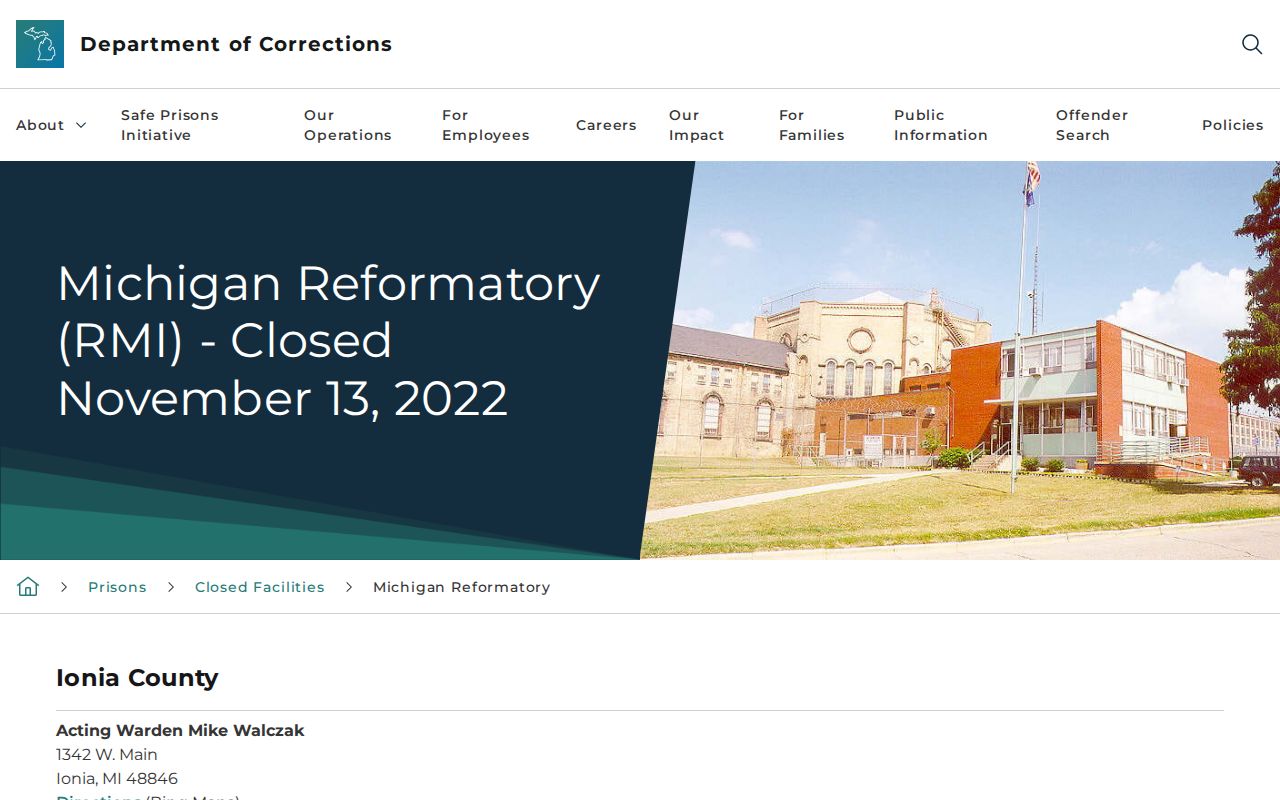
The state page confirms why a present-day search must move from the former institution name to OTIS, court records, and MDOC archives.
Ionia Prison Cluster and RMI Closure
Ionia County has an unusual mix of corrections names. Bellamy Creek Correctional Facility, Ionia Correctional Facility, and Richard A. Handlon Correctional Facility remain active MDOC prisons near West Bluewater Highway. Michigan Reformatory is the consequential fourth name in older local records, but it is closed. The Ionia County Correctional Center is a separate downtown county jail run by the Sheriff.
This cluster makes facility matching essential. “Ionia” in a result can mean the county of sentence, a state prison, the county jail, or a parole and probation office. A changed facility field after the RMI closure may show an MDOC transfer rather than release. Likewise, an old RMI address cannot identify current custody.
A person who moved to an active state prison remains under MDOC confinement. A person listed as Parolee has ordinarily left prison under supervision. A person listed as Discharged has reached the MDOC endpoint shown on the profile. The Ionia Correctional Facility release route illustrates how an active prison search differs from a closed-facility history.
Note: Resolve the operator and facility status before choosing a search, since county jail and MDOC records answer different questions.
Michigan Reformatory Search Limits
Closure, retention, and record removal create different search gaps. The closure explains why RMI cannot appear as an active facility. OTIS retention explains why a discharged profile may disappear after the public window. A set-aside can change public visibility sooner. None of those events proves the date of a past release.
Use the gap itself to choose the next source. If OTIS shows a person, read the status and sentence fields. If OTIS does not show an older discharge, use MDOC records and the sentencing court. If a court result is missing, check the correct county, court level, time limit, and confidential-record rules. Do not try to recover sealed or nonpublic material.
The confirmation chain is Historical RMI reference → OTIS profile or MDOC record → sentencing judgment → later receiving or supervising agency when applicable. That sequence preserves the difference between a prison transfer, parole, final discharge, and another authority’s custody.
Note: A closed facility name can support historical identification, but it cannot establish present custody or a final discharge.