
Ionia Correctional Release Paths
Ionia Correctional Facility, commonly shortened to ICF, is operated by the Michigan Department of Corrections. The active prison houses security Levels II and V. It is not part of the Ionia County Correctional Center. That distinction controls the search. A county roster or local recent-release list would not report a state-prison parole, discharge, or institutional transfer from ICF. Michigan’s Offender Tracking Information System, called OTIS, is the main public record for those state stages.
A prisoner may transfer from ICF to another MDOC prison without entering the community. A person granted parole ordinarily leaves prison under conditions and remains in MDOC supervision. Later, a Discharge Date can show the end of state custody or supervision. Another authority’s hold can also prevent physical freedom even when the Michigan sentence reaches parole status. “Paroled in custody” is one warning that the word paroled does not always mean the person is free.
Search Ionia Correctional Releases
The MDOC OTIS search includes current prisoners, parolees, probationers, and people discharged from state supervision within the public retention period. It excludes people who served only in county jail. Use an MDOC number when known because it is more precise than a common name. If only a name is available, compare all identifiers before opening the profile.
- Enter the MDOC number, or search by last and first name. Add other verified details only when needed to narrow the results.
- Select Prisoners for known custody, Parolees for post-prison supervision, Discharged for completed MDOC supervision, or All when the stage is uncertain.
- Match the result using date of birth, sex, race, MCL number, location, status, and sentence information. Do not assume the first similar name is correct.
- Open the profile. Read Current Status, Assigned Location, Earliest Release Date, Discharge Date, and each active or inactive sentence block.
- Confirm a disputed date or status with MDOC, the ICF record office, the assigned supervision office, and the sentencing-court record as appropriate.
The public search has separate fields for Last Name, First Name, Offender Number, Sex, Race, Age, Offender Status, and Marks/Scars/Tattoos. Search results add Parole Board Jurisdiction Date, Maximum Date, and Date Paroled. The Ionia County released-inmate search helps resolve a person’s custody type when “Ionia” could mean the county, the jail, a court, or a state prison.
Note: An ICF photograph can help match identity, but its Image Date is not a parole, release, or discharge date.
Ionia Correctional Release Fields
OTIS date labels answer different questions. Reading them as if they were interchangeable creates false release claims. An Earliest Release Date is normally an eligibility milestone, not an appointment to leave. A Parole Board Jurisdiction Date concerns when the Board may exercise authority. The Maximum Date is an outside sentence date under the applicable computation, while another sentence or hold may still matter.
| OTIS field | What it shows | What it does not prove |
|---|---|---|
| Current Status | Prisoner, parolee, discharged, or another listed MDOC stage | The exact physical place without checking Assigned Location |
| Assigned Location | A prison or supervision assignment tied to the profile | Community freedom when read by itself |
| Earliest Release Date | An eligibility calculation for the sentence | A guaranteed departure date |
| Date Paroled | The recorded start of parole status | The later end of state supervision |
| Discharge Date | The recorded endpoint of MDOC custody or supervision | That no other authority holds the person |
| Discharge Reason | The sentence-level reason MDOC closed that term | The outcome of every other case |
A blank Earliest Release Date on an already discharged profile does not override the actual discharge fields. For stronger confirmation, match the status event with the court judgment that imposed the sentence. OTIS warns that its data and projected dates can change, so the originating office remains the right place for a contested result.
Ionia Correctional Records Office
ICF has an administrative complex that includes a records office. That local detail makes the facility an important confirmation point for sentence and movement questions, while broader historical disclosure still belongs through MDOC records procedures. Call the main number and ask to be routed to the correct office. Staff may limit what can be given by telephone, and a formal records request may be required.
Ionia Correctional Facility (ICF)1576 W. Bluewater Highway
Ionia, MI 48846
616-527-6331
Operator: Michigan Department of Corrections
Use the facility record office for exact institutional timing and an MDOC request for older movement, parole, or discharge material that no longer appears in OTIS. Include the MDOC number, sentence or court file, facility name, and a narrow date range. Ask for existing records, not a new calculation. When the claimed error comes from the judgment, contact the sentencing court first. When it concerns supervision status, contact the assigned parole or probation office.
The official MDOC Ionia Correctional Facility page confirms the institution and its state-prison role.
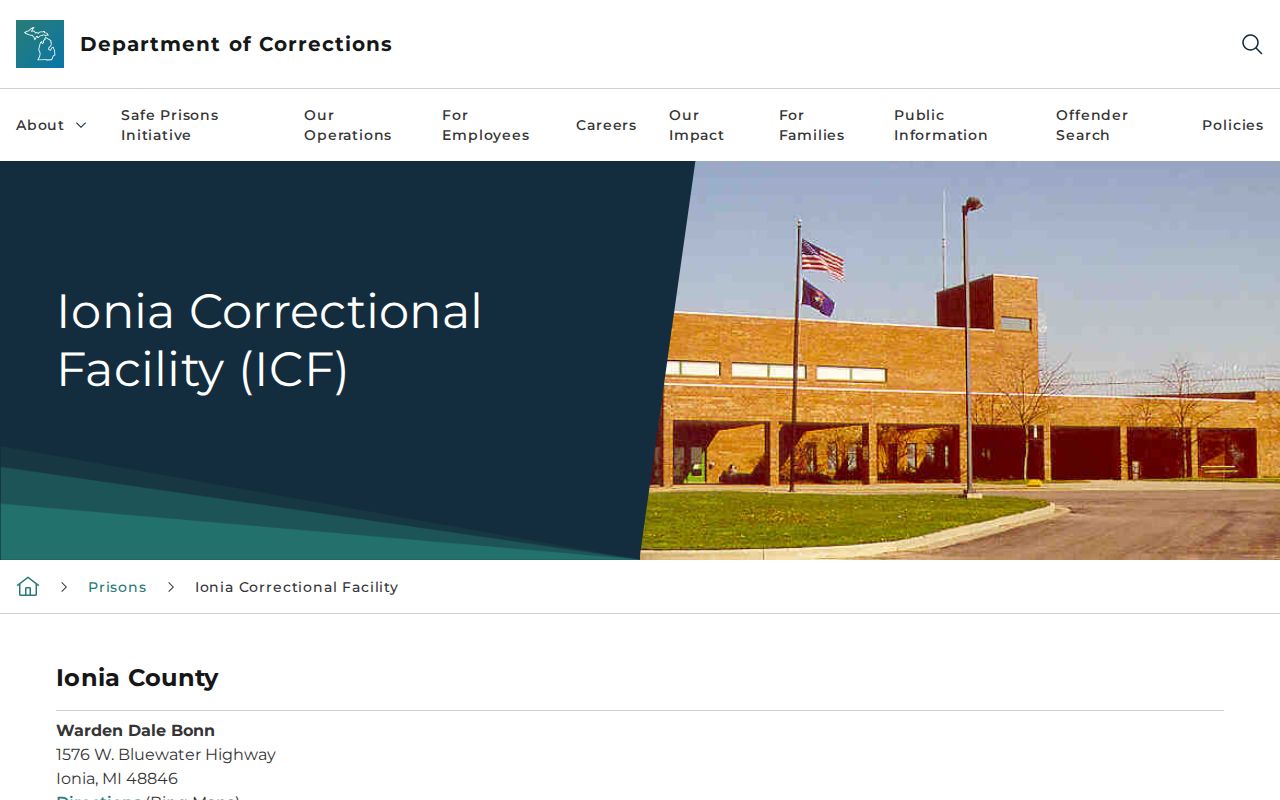
That identity check matters because several corrections sites and offices share the Ionia name.
Ionia Correctional Parole Process
ICF includes a parole-board hearing room, but the room’s presence does not mean every prisoner is eligible or approved. Michigan’s parole rules depend on the sentence, offense, offense date, and applicable law. For modern truth-in-sentencing cases, MDOC says a covered prisoner must serve the full judicial minimum before parole consideration. The minimum opens Board review. It is not release itself.
After a favorable decision, the MDOC Parole Release Unit records the decision, parole date, term, and special conditions, makes required notifications, and coordinates the approved plan. Departure can still await a suitable placement. MDOC also says a grant may be suspended before release because of misconduct or adverse information.
- Parole
- Conditional release from prison while the Michigan sentence remains under state supervision.
- Transfer
- A move to another institution or authority, not release to the community.
- Detainer
- A basis for another authority to hold or receive the person after the current custody stage.
- Discharge
- The recorded end of MDOC custody or supervision for the relevant state case.
If OTIS shows Parolee, use Assigned Location to find the supervising office. An office assignment is not a prison. The official Ionia County Parole/Probation Office is part of MDOC Region 4b, but a person may be assigned elsewhere based on the approved plan.
Note: A positive parole decision can precede departure because placement, notices, conduct, and another agency’s hold can still affect timing.
Which Ionia Prison Released Them?
Ionia Correctional Facility is one of three active MDOC prisons clustered in Ionia. Bellamy Creek, ICF, and Richard A. Handlon Correctional Facility all sit along West Bluewater Highway. Michigan Reformatory is another familiar Ionia name in older records, but MDOC closed it on November 13, 2022. An old article or status field may therefore name a place that is no longer a current prison.
Match the full facility name and MDOC number before drawing a release conclusion. “Ionia” on a result can refer to the county of conviction, an assigned supervision office, or one of the state institutions. A change from ICF to Bellamy Creek or Handlon is a prison transfer. It is not a county release. Likewise, the county jail on Adams Street is a separate Sheriff-run facility with a different record path.
For an older Michigan Reformatory reference, use OTIS while the person remains in its public scope, then turn to the sentencing court or MDOC records. Do not search a current county roster for a historic state-prison movement. Facility matching is the first step because every later status label depends on the right institution.
Confirm Ionia Correctional Discharge
The strongest public result uses more than one record. First, read OTIS Current Status and the actual Discharge Date. Next, inspect sentence-level Date of Discharge and Discharge Reason. Then compare the court judgment or register of actions that explains the sentence. If the event is recent, confirm it with ICF, MDOC, the Parole Release Unit, or the assigned supervision office.
OTIS keeps discharged people public for three years after supervision ends, unless a set-aside causes earlier removal. A no-result search can therefore reflect age or record-removal rules, not proof that the person was never at ICF. Use the sentencing court and an MDOC records request for older material. Do not try to defeat sealed, set-aside, confidential, or exempt status.
Finally, check any receiving authority named in the record. Discharged from MDOC does not certify that no county, another state, federal agency, or immigration authority holds the person. A matched status, date, court basis, and receiving-agency check distinguishes community release from transfer and gives the Ionia Correctional Facility record its correct meaning.