
Ionia Release Date Meanings
A date only makes sense with its label. The Michigan Department of Corrections uses several. An Earliest Release Date is generally an eligibility point. A Parole Board Jurisdiction Date marks when the Board may have authority to consider the case. A Maximum Date is an outside sentence milestone under the official computation. None of these alone promises that a prisoner will walk out that day. The Board still may deny or defer parole, a release plan may not be ready, or another authority may have a hold.
Date Paroled is historical evidence that parole status began. Parole is conditional release from prison while MDOC supervision continues. A later Discharge Date records the end of MDOC custody or supervision. That is different from the date a person first left a prison. OTIS, Michigan’s Offender Tracking Information System, may also show a sentence-level Date of Discharge and Discharge Reason. Those actual fields carry more weight than a past estimate.
Find an Ionia Release Date
Start with the system that has the person. OTIS covers MDOC prisoners, parolees, probationers, and people discharged from state supervision within its public window. It does not cover someone sentenced only to the Ionia County jail. The county publishes no online jail release-date tool, roster, or release archive. A federal or immigration transfer also requires a different system. A missing county name therefore cannot be treated as proof of release.
- Identify the holding authority. Separate the Ionia County Correctional Center from Bellamy Creek, Ionia Correctional, and Handlon, which are state prisons.
- For an MDOC case, open the OTIS offender search. Use the MDOC number when known, or search by name and match the result with identifying and sentence details.
- Open the profile. Read Current Status, Assigned Location, Earliest Release Date, Discharge Date, and the sentence blocks. In results, also check Parole Board Jurisdiction Date, Maximum Date, and Date Paroled.
- For a county-jail sentence, call Jail/Inmate Info and review the sentencing court file. Ask for the sentence, jail credit, other holds, and the recorded release or transfer event.
- Confirm a disputed or consequential date with the facility record office, MDOC, the supervising office, or the sentencing court. Use the agency that made the relevant entry.
The full Ionia County released-person search path is available on the home page. It helps distinguish a community release from a transfer when the responsible system is still unclear.
Michigan’s OTIS terms and accuracy notice explain why public status and date data can change. The search should be treated as a strong lead, followed by direct confirmation. The official Parole Release Unit page shows the state office responsible for the post-decision release process.
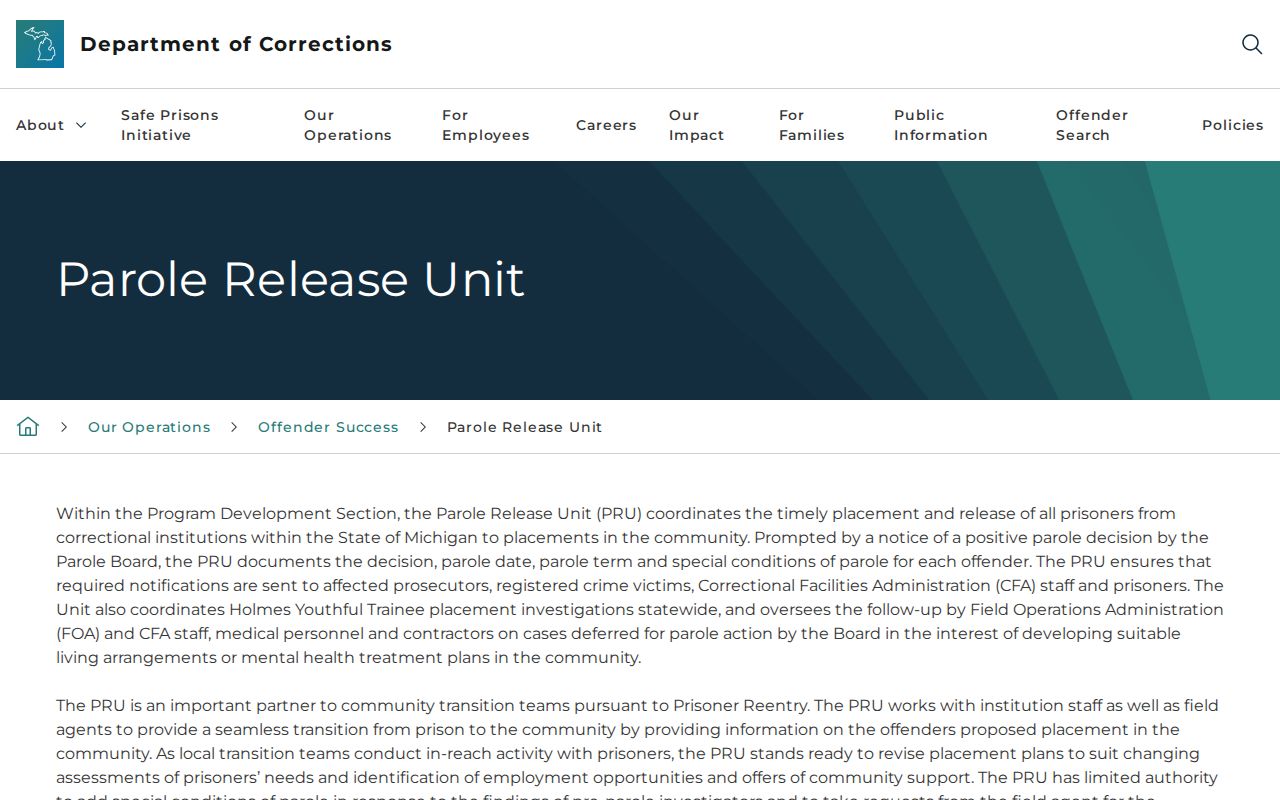
That process explains why a favorable parole decision and a physical departure date may not match.
Note: Assigned Location can name a prison or supervision office, so the field should never be read alone as proof of freedom.
Ionia Release Dates Under Michigan Law
Modern Michigan truth in sentencing is not an approximate 85 percent rule. The official MDOC truth-in-sentencing explanation says covered prisoners must serve the full judicial minimum before parole consideration. The framework applies to assaultive crimes committed on or after December 15, 1998, and all other crimes committed on or after December 15, 2000. It eliminated good time and disciplinary credits for those covered offenses. The minimum opens the parole consideration stage. It does not guarantee release.
For covered cases, disciplinary time replaces older credit concepts. Class I misconduct days are considered by the Parole Board, rather than being treated as a simple number that anyone can subtract from a sentence. MCL 800.33(14) makes a prisoner subject to disciplinary time ineligible for good time, special good time, disciplinary credits, and special disciplinary credits. MCL 791.233 and 791.234 govern parole authority and key jurisdiction or eligibility rules.
The official state explanation is visible in the captured source below.
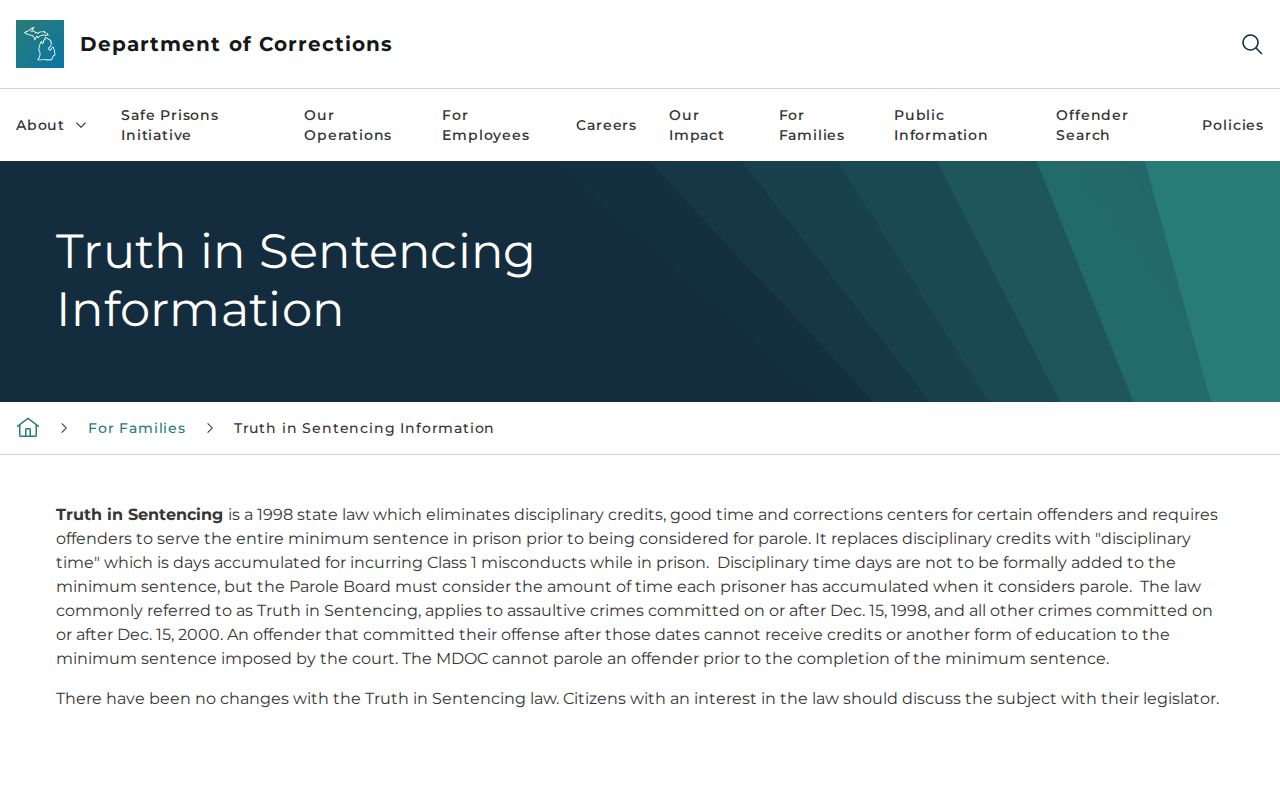
This source makes the offense date and judicial minimum central to the Ionia release-date inquiry.
Older Ionia Sentence Calculations
Some older sentences fall under older statutory credit systems. MCL 800.33 contains the good-time schedule for eligible cases before April 1, 1987. For some eligible cases after that date but outside modern disciplinary-time coverage, the law provides disciplinary credit of five days per month and up to two special days. A major-misconduct month can cause credit loss, and the statute has detailed limits.
No sound estimate can be made from sentence length alone. The offense date, statute, minimum and maximum terms, time credited by the court, misconduct record, and any consecutive sentence all matter. A consecutive term runs in sequence rather than at the same time. A concurrent term generally runs alongside another term, subject to the official judgment and computation. Specialized life, drug, and medical provisions also have their own rules. Some offenses are not eligible for parole.
- Judicial minimum
- The minimum term imposed by the sentencing court before parole consideration under the rules that apply to the case.
- Jail credit
- Time the court credits toward a sentence, as shown by the judgment and official computation.
- Disciplinary time
- Misconduct time considered in Michigan’s modern framework, not a public release-date calculator.
- Discharge
- The recorded end of MDOC custody or supervision, not merely the day prison confinement ended.
Note: The exact offense date is vital because Michigan’s credit rules changed over time and do not apply to every sentence alike.
Ionia County Jail Good Time
A sentence at the Ionia County Correctional Center follows a separate county-jail rule. MCL 51.282 provides one day of good time for each six days of a county-jail sentence when the person has not violated jail rules. The sheriff administers forfeiture and restoration. This statute does not create a public Ionia County release-date feed, and it cannot yield a dependable date without the jail’s own facts.
The starting date, court-awarded credit, eligible sentence days, any forfeiture or restoration, another case, and a new court order can all affect the actual result. Pretrial detention is different. A person awaiting trial has no sentence-based release date. Departure may depend on posting cash, ten-percent, or surety bond, receiving personal recognizance, dismissal, or another court order. Even then, a detainer may cause transfer instead of release to the community.
Call the Ionia County Correctional Center’s Jail/Inmate Info line at 616-527-5390 and check the court docket. If the question concerns what the judge ordered, MiCOURT or the court’s Judgment of Sentence is the right record. If it concerns the hour the jail processed a release or transfer, ask for the jail movement or release entry.
Read the court and jail records together. A judgment can show the term, sentence date, and jail credit, but it may not record the precise hour the Booking Desk processed departure. A jail entry can show that physical event, yet the entry may not explain every part of the judge’s order. Bond also needs context. Cash, ten-percent, surety, and personal-recognizance bonds can permit pretrial release, but they do not end the criminal case. If staff report a transfer to MDOC or another county, search the receiving authority before calling the person released. That matched-record method is more reliable than adding days to a sentence on a calendar.
Why Ionia Release Dates Change
Projected dates move because the legal and custody facts move. OTIS itself warns against taking action on changing data without confirmation. The reason for a revision should come from the agency record, not a guess based on the new date.
| Factor | How it affects the timeline | Best confirmation |
|---|---|---|
| Court correction | An amended judgment or corrected jail credit changes the official computation. | Sentencing court and updated judgment |
| Sentence structure | Consecutive terms, a new conviction, or another active sentence can extend custody. | Court file and MDOC sentence blocks |
| Conduct | Misconduct, disciplinary time, or loss of an older credit can affect eligibility. | Facility record office or MDOC |
| Parole action | The Board may grant, deny, or defer, and a grant can be suspended before departure. | Parole Release Unit and OTIS |
| Release plan | Placement or another required part of the plan may still need approval. | Parole Release Unit or assigned office |
| Detainer or hold | Another county, state, federal, or immigration authority may take custody. | Holding and receiving agencies |
A detainer is a request or legal basis for another authority to hold or receive a person. It can turn an expected community release into a transfer. “Paroled in custody” can likewise mean the Michigan sentence reached parole status while another authority still confines the person.
Confirm Ionia Release Date Changes
For a state prisoner, compare OTIS with the sentencing judgment and contact the facility record office or MDOC when the date is disputed. The Parole Release Unit handles questions tied to an approved parole date, placement, and release coordination. A positive Board decision can still await an approved plan or be suspended after misconduct or adverse information.
For a county detainee, call Jail/Inmate Info and then check the Ionia court that controls the case. Misdemeanors ordinarily remain in 64-A District Court. Felonies begin there and generally move to 8th Circuit Court after bindover. Ask the jail whether the event was a community release or transfer. A VINE alert may give fast notice of a change, but it is not a certified release record. The VINELink Release Check explains the county and state notification route.
The old MDOC family packet described many prison parole releases as processed early, often around or shortly after 8 a.m. The archive is labeled OLD_2023 and does not govern Ionia County jail releases. The county publishes no set release hour. Exact timing belongs with the facility record office.
Note: A blank Earliest Release Date on an already discharged OTIS profile does not cancel the recorded discharge fields.